
Student Loan vs Education Loan: Interest Rate Difference in India
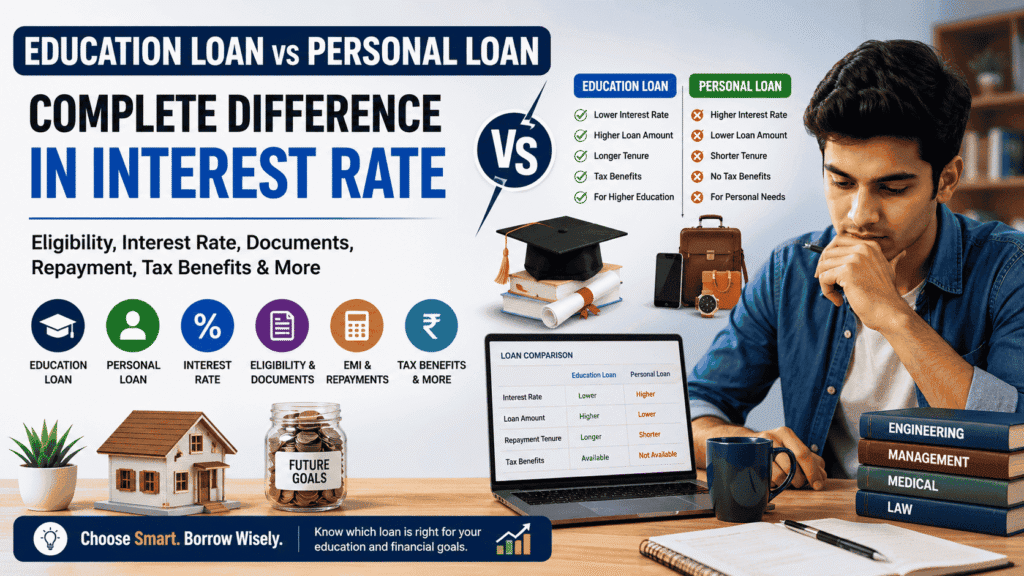
Table of Contents
- Student Loan vs Education Loan in India: Is There an Interest Rate Difference?
- Student Loan vs Education Loan: Are They the Same?
- Current Education Loan Interest Rates in India
- Secured vs Unsecured Education Loans
- How Is Education Loan Interest Calculated?
- Does Education Loan Interest Accumulate During the Moratorium?
- Student Loan vs Education Loan: Total Cost Comparison
- Girl Student Concession & Government Subsidy
- Education Loan vs Personal Loan for Higher Education
- What Documents Are Usually Required for an Education Loan?
- How Much Education Loan Should You Actually Borrow?
- How to Choose the Best Education Loan
- Common Education Loan Mistakes Students Make
- Student Loan vs Education Loan: What Should You Choose?
- Sources & References
- FAQs
1. Student Loan vs Education Loan in India: Is There an Interest Rate Difference?

Say you’ve just got admission into a college that costs ₹9 lakh for the full course. You open two bank websites to compare loans. One calls its product a “student loan.” The other calls it an “education loan.” The interest rates shown are different — 8.9% on one page, 11.5% on the other. Naturally, you assume the loan type itself is the reason.
It isn’t.
In India, banks and NBFCs don’t follow one standard name for education financing. Some call it a student loan, some call it an education loan, some call it a study loan. The name on the product page tells you almost nothing about the price you’ll actually pay. What decides your interest rate is the specific scheme, the lender, whether you’re offering collateral, your co-applicant’s profile, and a few other factors we’ll walk through here.
This article breaks down exactly what causes the rate differences you’re seeing, how education loan interest is actually calculated, what happens to that interest while you’re still studying, and how to compare offers properly instead of chasing the lowest number on a homepage. If you want to run your own numbers as you read, keep our Education Loan EMI Calculator open in another tab.
2. Student Loan vs Education Loan: Are They the Same?
Short answer: yes, in the Indian market, they refer to the same underlying product — a loan taken specifically to fund higher education, repaid with interest, usually with a repayment holiday built in for the study period.
What’s called a “student loan”: Typically used by NBFCs(Non-Banking Financial Company) and some digital-first lenders. It’s marketing language borrowed loosely from how the term is used in the US, where “student loan” specifically means federal or private education financing.
What’s called an “education loan”: The term used by most public sector and private banks in India — SBI, Bank of Baroda, PNB, HDFC Bank, ICICI Bank, and others.
Why the naming differs: There’s no RBI classification that separates “student loans” from “education loans” as distinct products with different rules. Lenders choose the name that fits their branding. A “student loan” from an NBFC and an “education loan” from a bank are structurally the same thing — money borrowed for tuition, hostel, books, and related costs, repaid after a moratorium period.
What you should actually compare instead of the name:
- Is it secured (needs collateral) or unsecured
- What’s the interest rate range, and is it fixed or floating
- What’s the processing fee
- How is interest during the moratorium handled
- What repayment tenure and prepayment terms apply
Think of it like “mobile recharge” vs “mobile plan” — different words, same product, and the price depends on which specific plan you pick, not which word the company used for it.
3. Student Loan vs Education Loan Interest Rate Difference

Does a Student Loan Have a Lower Interest Rate?
No — not automatically, and not because of the name. You’ll find NBFC “student loans” priced higher than PSU( Public Sector Undertaking) bank “education loans,” and you’ll also find NBFC options priced competitively for students who don’t have collateral to offer. The label doesn’t set the price. The lender, scheme, and your specific application do.
This is where a lot of comparison content online gets it wrong — it implies one category is cheaper by default. It isn’t. Two loans with different names can have the same rate, and two loans with the same name can have a 3–4 percentage point gap between them.
What Actually Determines the Interest Rate?
- Lender type: Public sector banks generally price lower than private banks, and NBFCs are usually priced highest — but with faster processing and fewer collateral demands in exchange.
- Secured vs unsecured: Offering property, fixed deposits, or other collateral typically gets you a meaningfully lower rate than an unsecured loan.
- Loan amount and course: Loans for recognized, well-ranked institutions (IITs, IIMs, top foreign universities on a bank’s approved list) often qualify for special lower-rate schemes.
- Study destination: Domestic education loans and study-abroad loans are frequently priced on separate rate cards, with abroad loans sometimes carrying a different spread.
- Co-applicant’s profile: A parent or guardian co-applicant with stable income and a good credit score can improve your sanctioned rate.
- Benchmark linkage: Most bank loans are floating-rate, linked to an external benchmark like the repo rate; NBFC loans are often linked to their own internal benchmark rate, which can move independently of RBI policy.
- Government scheme eligibility: Interest subsidy schemes (covered later) don’t change your contract rate, but they change what you actually end up paying.
Why Two Students Can Get Different Interest Rates
Here’s a simple illustration, not a real case — just to show how the same loan amount can price differently.
Student A: Needs ₹7 lakh, is joining a well-known engineering college, has a family-owned property to pledge as collateral, and has a parent with a stable salaried income as co-applicant. A bank is likely to offer this profile a rate closer to the lower end of its published range, since the risk is well-covered.
Student B: Needs the same ₹7 lakh, is joining a private college, has no property to offer, and their co-applicant’s income is modest. This profile is more likely to land on the higher end of the range, or may need to go the unsecured NBFC route, which usually costs more.
Same amount, same purpose, different final rate — nothing to do with whether the product was called a “student loan” or an “education loan.”
4. Current Education Loan Interest Rates in India
Rates below are indicative starting ranges compiled from lender and industry sources as of mid-2026. Actual rates depend on your specific scheme, collateral, and profile, and they change with RBI policy and internal benchmark revisions. Always confirm the current rate on the official website before applying.
| Lender | Scheme Type | Indicative Rate Range | Collateral | Study Type | Note |
|---|---|---|---|---|---|
| SBI | Scholar Loan (top institutes) | ~6.90% – 7.65% | Varies by amount | India | Restricted to select premier institutes like IITs/IIMs/ISB |
| SBI | Global Ed-Vantage | ~9.15% – 9.65% onward | Required above threshold | Abroad | Flat processing fee, 15% margin money typically applies |
| Bank of Baroda / PNB / Canara | Scholar/study loan schemes | ~7% – 12% (wide range reported across sources) | Required above threshold | India/Abroad | Rate depends heavily on institute, amount, and collateral — figures vary meaningfully across public listings, so treat this as a rough band, not a quote |
| HDFC Bank / ICICI Bank | Education loan | ~9.50% – 13.50% | Depends on amount | India/Abroad | Faster digital processing than PSU banks |
| HDFC Credila | Secured / Unsecured | ~9.75% (secured) to ~13.50% (unsecured) | Optional | Mostly abroad-focused | Floating, linked to internal benchmark (CBLR) |
| Other NBFCs (Avanse, Propelld, Auxilo) | Secured / Unsecured | ~9.75% – 14% | Optional | India/Abroad | Faster sanction, higher processing fee than PSU banks |
You can cross-check current published rates directly on the lender’s own page — for instance, SBI’s education loan schemes page or the SBI Global Ed-Vantage scheme page for study-abroad loans — since these are updated more frequently than most comparison articles, including this one. Worth flagging: even well-known aggregator sites currently quote noticeably different numbers for the same SBI scheme — some list the standard Student Loan Scheme around 8%–9%, others closer to 10%–11%. That gap itself is useful evidence for the core argument of this article: published “starting rates” shift often enough that the only number worth trusting is the one your branch actually quotes you.
Why the “starting rate” isn’t necessarily your rate: Every published range has a floor and a ceiling. The floor is usually reserved for the strongest profiles — top-ranked institute, full collateral, high co-applicant income. Most applicants land somewhere in the middle or upper part of the range. Treat the advertised starting figure as a best-case number, not a quote.
Fixed vs floating: Most PSU bank loans are floating, moving with the repo-linked benchmark. NBFC loans float against their own internal benchmark, which the lender can revise at its discretion — so a Credila or Avanse rate can change even without an RBI rate move.
Last updated: August 2026 — verify current figures directly with the lender before applying, since these are revised periodically.
5. Secured vs Unsecured Education Loans
Secured education loan: You (or your co-applicant) pledge collateral — property, fixed deposits, insurance policies, or similar assets — against the loan. In exchange, lenders typically offer a lower rate and can approve larger amounts, since their risk is covered by the asset. Most PSU banks require collateral once the loan crosses roughly ₹7.5 lakh to ₹10 lakh, though the exact threshold varies by bank and scheme.
Unsecured education loan: No property or asset is pledged. Approval relies more heavily on the co-applicant’s income, credit history, and sometimes the reputation of the institute/course. These loans are faster to process but usually carry a rate premium of a few percentage points over secured options from the same lender.
Which one costs less? Secured loans are typically cheaper on a pure interest-rate basis. But “no collateral” doesn’t mean “no obligation” — you and your co-applicant are still fully liable for repayment either way. The real trade-off is: secured loans cost less but take longer and need an asset to pledge; unsecured loans are faster and asset-free but cost more over the loan’s life. See our Personal Loan vs Education Loan comparison if you’re weighing an unsecured option outside the education-loan category entirely.
6. How Is Education Loan Interest Calculated?
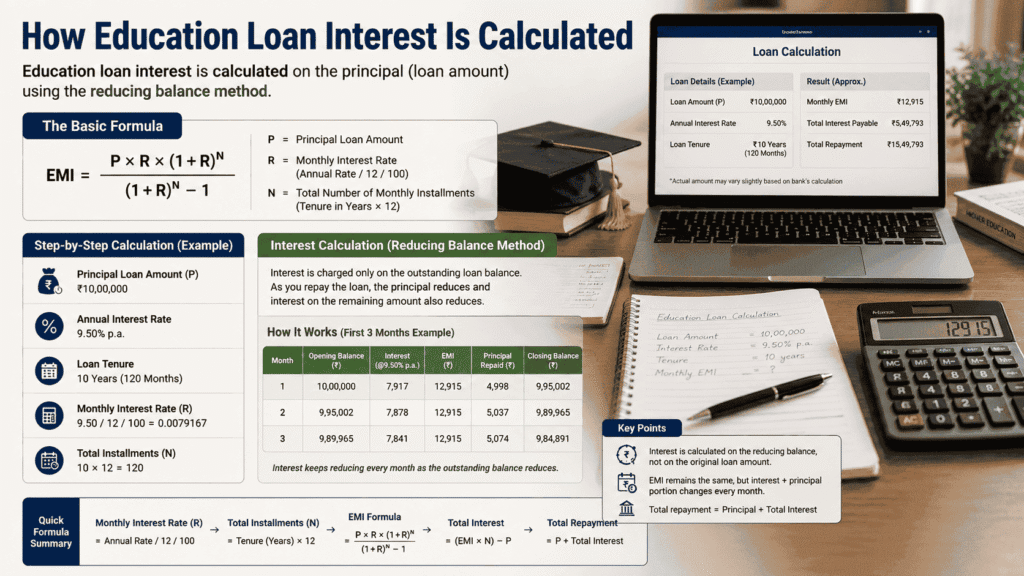
Education loan interest is almost always calculated on a reducing balance basis — meaning interest is charged only on the outstanding principal, not the original loan amount, and it recalculates as you repay.
Here’s a simplified example using round numbers (illustrative, not a lender quote):
Let’s make this simple.
Suppose you borrow:
- Loan amount: ₹10,00,000
- Interest rate: 9% per year
- Repayment period: 10 years
- EMI calculation: standard reducing-balance EMI
- Moratorium interest: not included in this basic EMI example
At 9% for 10 years, the approximate EMI is: ₹12,668 per month
Over 120 monthly payments, the total repayment would be about: ₹15.20 lakh
That means the approximate interest component over the 10-year repayment period would be:
₹5.20 lakh
These are illustrative calculations, not a bank quotation. The actual cost can be higher if interest accumulates during the study and moratorium period and is later added to the outstanding principal.
The key distinction to keep straight: your annual interest rate is the pricing figure quoted by the bank; your EMI is the fixed monthly amount you pay; your total interest is the sum of all interest paid over the loan’s life; and your total repayment is principal plus total interest combined. Confusing these is one of the most common reasons students underestimate what a loan will actually cost them. For a full walkthrough of the formula, see How to Calculate EMI: A Step-by-Step Guide.
7. Does Education Loan Interest Accumulate During the Moratorium?
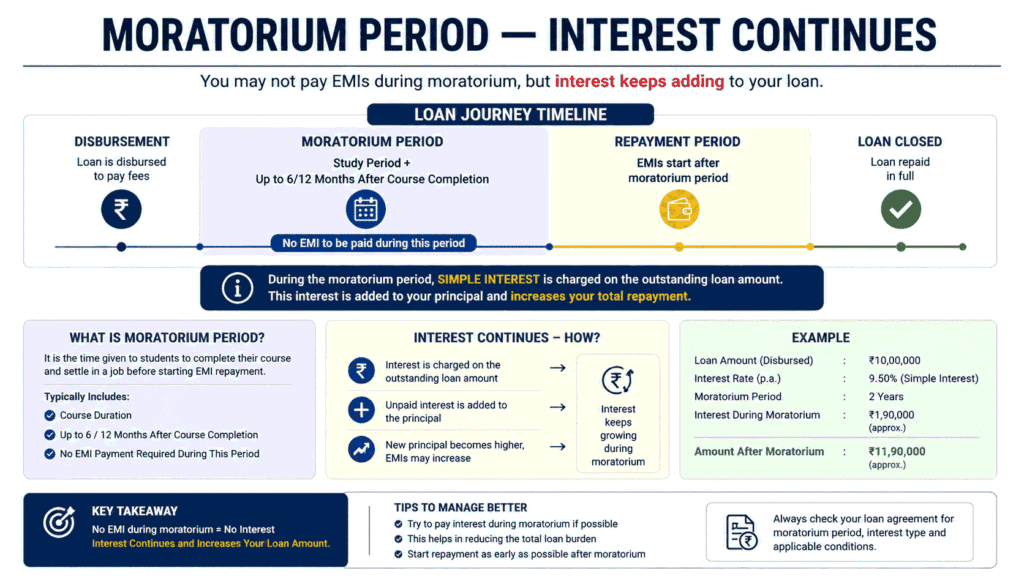
What is the moratorium? It’s the period during which you’re not required to pay EMIs — typically your course duration plus a grace period of six months to a year after completion, before repayment officially begins.
Does interest keep building during this time? Yes, in almost every case. The bank isn’t charging you EMIs, but simple interest still accrues on the amount already disbursed to your college, month after month, for the entire duration of your course and grace period.
What happens to that unpaid interest? At the end of the moratorium, many lenders add the accumulated interest to your principal — a process called capitalization — before calculating your EMI. This means your EMI going forward is based on a higher principal than what you originally borrowed.
A simplified illustration: if you draw down ₹10 lakh gradually over a 4-year course at 9% interest, and none of that interest is paid during the moratorium, the accumulated interest by the time you finish could easily be in the ₹2–3 lakh range, depending on the exact disbursement schedule. That amount often gets folded into your principal, meaning your EMI is calculated on close to ₹12–13 lakh, not ₹10 lakh.
Why this matters: “No EMI during college” is often read as “no cost during college.” It isn’t. If you or your family can afford to pay even the interest portion during the study period, it meaningfully reduces your total repayment later. Several lenders and government subsidy schemes explicitly reward this with an extra rate concession — covered next. For more on how this period works lender to lender, see our Education Loan Moratorium Period Explained.
8. Student Loan vs Education Loan: Total Cost Comparison
The interest rate is only one line item. Two loans with a similar rate can still cost very differently once you add everything else.
| Cost/Term | What to Check |
|---|---|
| Interest rate | Whether it’s the actual rate you’ll get, not just the advertised floor |
| Processing fee | Often 1%–1.5% + GST at NBFCs; frequently a flat, lower fee at PSU banks |
| Insurance | Whether a loan-linked insurance is mandatory and its cost |
| Collateral | Whether required, and the valuation/legal costs involved |
| Moratorium | Full duration, and whether it covers course + grace period |
| Interest during moratorium | Whether it’s capitalized, and whether partial payment is allowed |
| Prepayment | Whether allowed without penalty, and any lock-in period |
| Repayment period | Total years available to repay after moratorium |
| Subsidy eligibility | Whether you qualify for any government interest support |
| Total repayment | Principal + total interest + fees, over the full tenure |
Why the lowest rate isn’t always the cheapest loan: Say Loan A offers 9.5% but charges 1.25% + GST as a processing fee and doesn’t allow free prepayment for two years. Loan B offers 10% but has a flat, low processing fee and lets you prepay anytime without charge. If you’re planning to prepay early — say, once you get a job — Loan B can end up cheaper overall despite the higher headline rate, because you’re not stuck paying interest on the full remaining tenure. This is exactly why the total-cost table above matters more than a single percentage figure.
9. Girl Student Concession & Government Subsidy
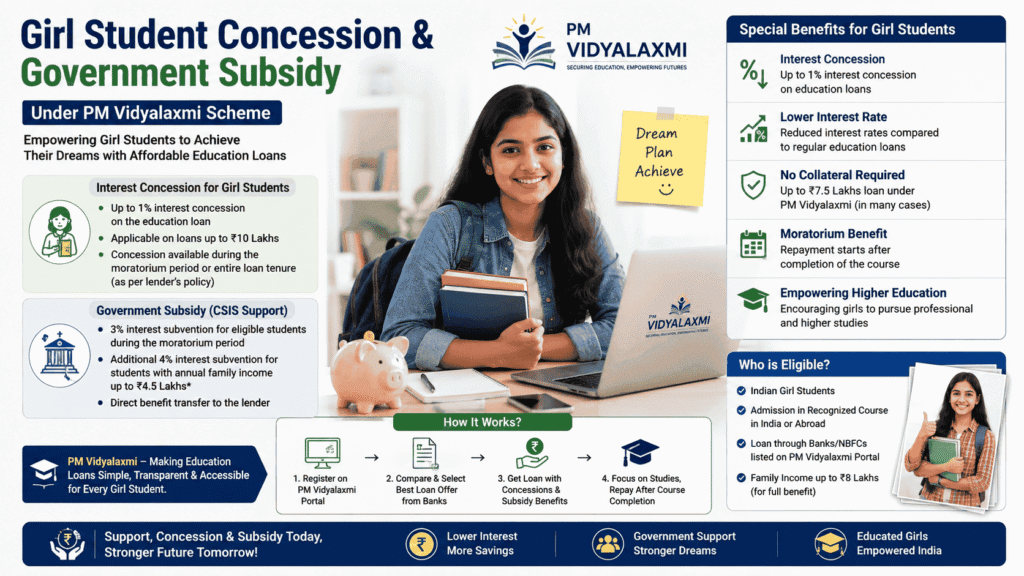
These are two different things, and mixing them up is a common mistake.
Girl Student Interest Concession
Several public sector banks offer a small interest rate concession for female applicants — commonly cited around 0.50% at institutions like SBI, though this varies by lender and specific scheme, and isn’t universal across every education loan product. Since exact figures change and differ bank to bank, check the specific scheme’s current terms rather than assuming a fixed number applies everywhere.
Government Interest Subsidy (PM-Vidyalaxmi / CSIS)
This is not a discount on your contract interest rate — it’s the government paying part or all of your interest during the moratorium period, on your behalf, if you qualify.
Under the PM-Vidyalaxmi scheme, launched by the central government, education loans routed through the official PM-Vidyalaxmi portal for admissions at recognized institutions can carry the following benefits, as per an official government release:
- Students pursuing technical or professional courses at NAAC/NBA-accredited institutions with annual family income up to ₹4.5 lakh are eligible for 100% interest subvention during the moratorium period, on education loans up to ₹10 lakh.
- Students with family income up to ₹8 lakh can receive a 3% interest subsidy on loans up to ₹10 lakh, with a total scheme outlay reserved through 2030-31.
- A government credit guarantee (commonly cited at 75% for loans up to ₹7.5 lakh) helps banks sanction collateral-free loans with more confidence, though borrowers remain fully responsible for repayment.
These benefits apply only to loans processed through the eligible pathway and to income-qualified applicants — not to every education loan taken in India. If you don’t route your application through the scheme or don’t meet the income criteria, your loan won’t automatically carry this subsidy. A related, older scheme worth knowing about is the Central Sector Interest Subsidy (CSIS) as explained on SBI’s site, which covers a similar income bracket for technical/professional courses in India. Confirm eligibility and current terms directly on the official PM-Vidyalaxmi portal before assuming you qualify.
10. Education Loan vs Personal Loan for Higher Education
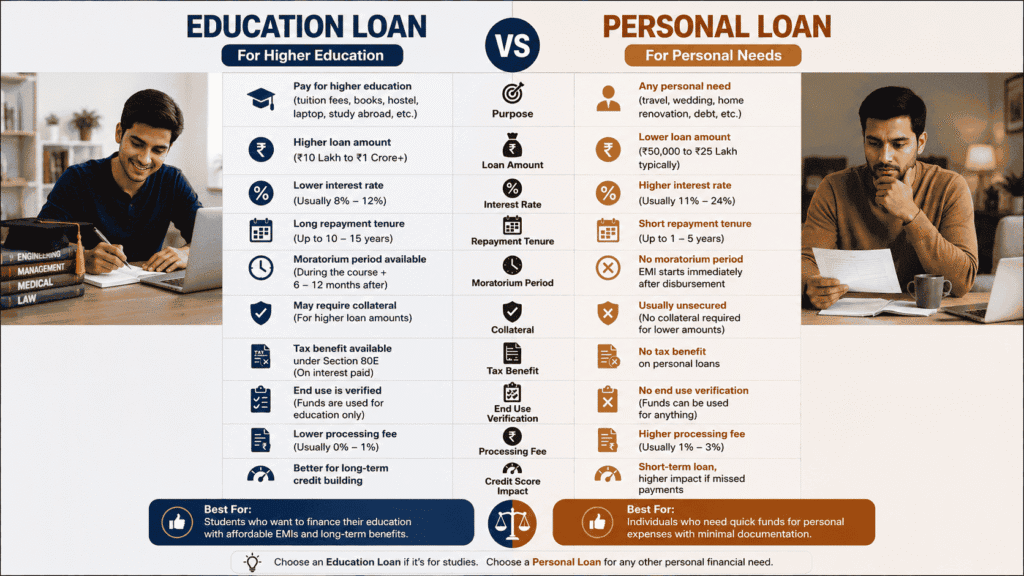
Some students, especially those who don’t have collateral or a strong co-applicant, consider a personal loan instead. Here’s how they compare structurally:
- Purpose: Education loans are specifically for education costs; personal loans can be used for anything, including education.
- Interest cost: Education loans are generally priced lower than personal loans, since education lending is treated as priority-sector lending by RBI, which keeps rates comparatively favorable for banks to offer.
- Collateral: Personal loans are almost always unsecured but usually cap out at lower amounts than a secured education loan.
- Tax benefit: Only education loan interest qualifies for the Section 80E deduction (details below) — personal loan interest does not, regardless of what it’s used for. One nuance worth knowing upfront: this benefit only applies if you file under the old tax regime, so it shouldn’t be the deciding factor if you’ve already moved to the new regime.
- Repayment: Education loans typically offer a moratorium; personal loans usually require EMIs to start almost immediately.
Don’t assume education loans always win — for very small amounts with a short repayment horizon and a strong applicant, a personal loan’s faster processing can occasionally make sense. But for meaningful education costs, compare the actual offers rather than assuming one category is automatically better. For a deeper breakdown, see Personal Loan vs Education Loan: Full Comparison.
11. What Documents Are Usually Required for an Education Loan?
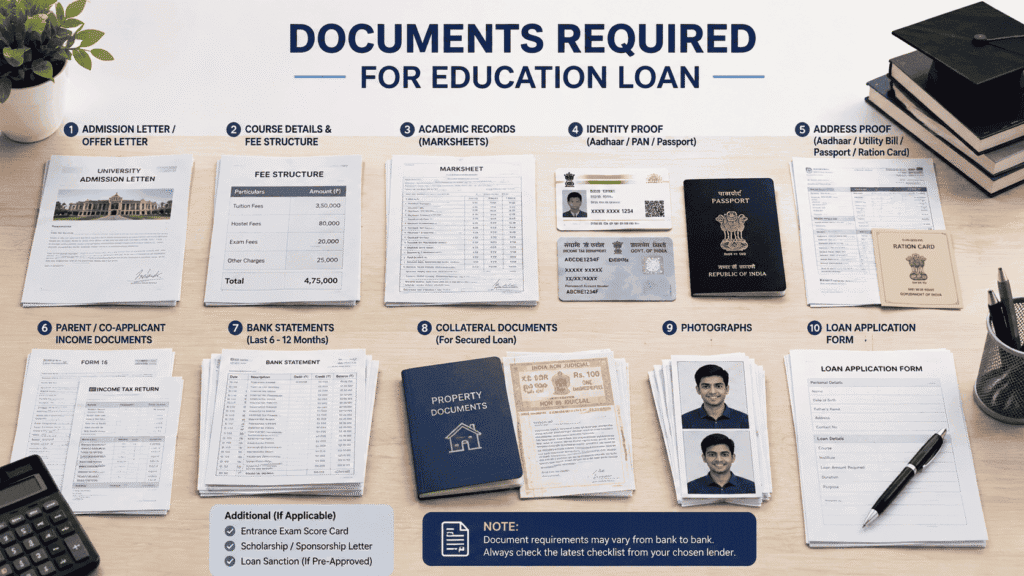
Requirements vary by lender, but most applications need:
- Admission or offer letter from the institution
- Fee structure/cost estimate from the college or university
- Academic records (mark sheets, entrance exam scores where applicable)
- Identity and address proof of the student and co-applicant
- Income proof of the co-applicant (salary slips, ITR, or bank statements)
- Collateral documents, if the loan is secured
- Passport and visa documents, for study-abroad applications
Always check the specific lender’s checklist before applying, since NBFCs and banks differ in what they ask for.
12. How Much Education Loan Should You Actually Borrow?
Borrowing the maximum you’re eligible for isn’t the same as borrowing what you actually need.
- Start from your actual eligible expenses — tuition, hostel/accommodation, essential books and equipment — not a round number.
- Subtract any scholarships, grants, or family contribution you can realistically arrange upfront.
- Estimate your likely post-study EMI against a realistic, not optimistic, expected starting salary in your field.
- Avoid rounding up “just in case” — every extra rupee borrowed accrues interest for the full tenure, including during the moratorium.
- If possible, keep some buffer for unplanned costs rather than building it into the loan itself, since unused borrowed funds still cost you interest.
See our Student Budget Planning Guide for help estimating your real cost of living alongside tuition.
13. How to Choose the Best Education Loan?
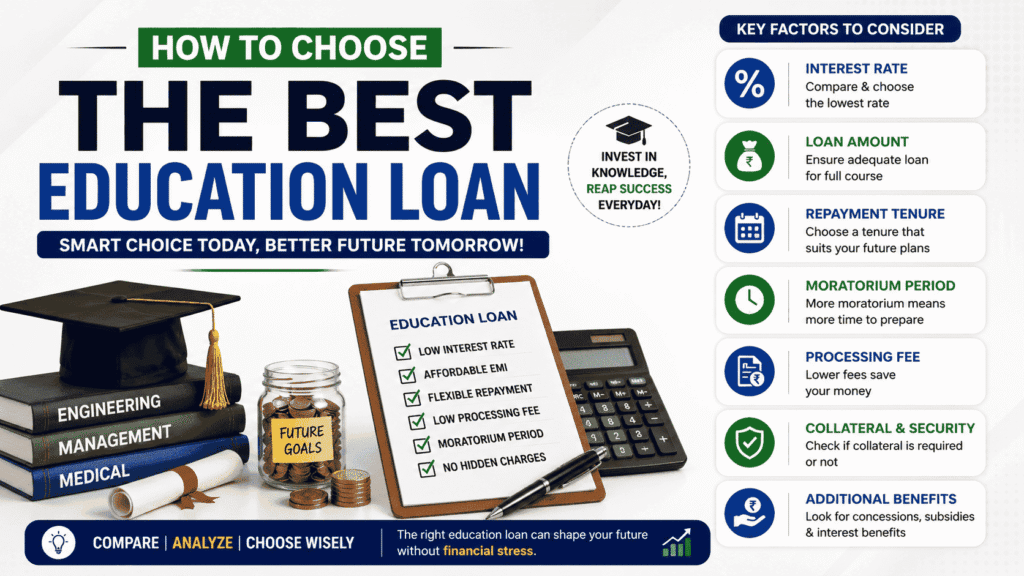
Rather than searching for “the best bank,” use this as a comparison checklist across at least two or three lenders:
- Compare the actual quoted rate for your profile, not just the advertised range
- Confirm whether it’s fixed or floating, and which benchmark it’s linked to
- Add up the processing fee, including GST
- Check whether collateral is required, and at what threshold
- Understand the full moratorium period, including any grace period after course completion
- Ask specifically how unpaid interest during the moratorium is treated — capitalized or not
- Check prepayment rules and any lock-in period
- Check whether you qualify for a government subsidy or girl-student concession
- Calculate the total repayment amount, not just the EMI
- Read the sanction letter fully before accepting, especially the fine print on fees and penalties
14. Common Education Loan Mistakes Students Make
Mistake 1: Choosing only by the lowest advertised interest rate. The advertised floor rate is often reserved for the strongest applicants; your actual quote may be higher.
Mistake 2: Assuming no EMI means no interest. As covered above, interest usually accrues silently during the moratorium even without EMIs.
Mistake 3: Ignoring processing fees. A lower rate with a high processing fee can cost more upfront than a slightly higher rate with a smaller fee.
Mistake 4: Not checking whether the rate is floating. A floating rate can rise during your repayment period, changing your EMI even after disbursal.
Mistake 5: Borrowing more than necessary. Extra borrowed amount accrues interest for the entire tenure, even if it goes unused.
Mistake 6: Not comparing multiple lenders. Rates and terms genuinely vary enough between banks and NBFCs that comparing at least two or three offers is worth the time.
Mistake 7: Ignoring government subsidy eligibility. Some applicants qualify for meaningful interest subvention but never apply through the eligible route.
Mistake 8: Not understanding collateral requirements. Assuming a loan is collateral-free without confirming the threshold at which it stops being so.
Mistake 9: Ignoring total repayment. Focusing on the monthly EMI figure without checking what the loan costs in total over its full life.
Mistake 10: Signing without reading the loan terms. Especially clauses on rate reset frequency, prepayment charges, and what happens during a repayment gap.
15. Sources & References
- Press Information Bureau, Government of India — PM-Vidyalaxmi / PM-USP CSIS scheme details
- Official PM-Vidyalaxmi Portal
- Income Tax Department e-Filing Portal — Section 80E provisions
- SBI Education Loan Schemes — Official Page
- SBI Global Ed-Vantage Scheme — Official Page
- SBI CSIS Interest Subsidy Scheme — Official Page
Disclaimer: This article is for general informational purposes only and does not constitute financial, investment, or tax advice. Interest rates, processing fees, government subsidy eligibility, and tax provisions mentioned above are indicative and can change without notice. Please verify current terms directly with the lender, the PM-Vidyalaxmi portal, or a qualified financial/tax advisor before making any borrowing decision.
Frequently Asked Questions
What CIBIL score is needed for an education loan?
Most banks look for a co-applicant CIBIL score of 700 or above, though some PSU banks are more flexible for first-time borrowers with no credit history yet. A weak score usually doesn’t block the loan outright — it can just mean a higher rate or a request for stronger collateral.
Who can be a guarantor for an education loan?
Typically a parent, guardian, or close relative with a stable income can act as co-applicant/guarantor. Some lenders also accept a third-party guarantor if immediate family isn’t available, though requirements vary by bank and loan amount.
Government bank ya private bank — education loan ke liye kaun better hai?
PSU banks generally offer lower interest rates but take longer to process and often need collateral sooner. Private banks and NBFCs process faster with less paperwork but usually charge more. If you have time and collateral, PSU banks tend to work out cheaper overall.
Why do education loan applications get rejected?
Common reasons include a weak co-applicant income or credit profile, an unrecognized or unlisted institution, incomplete documentation, or requesting an amount that doesn’t match the actual course cost. Applying to a lender whose approved-institution list doesn’t include your college is a frequent, avoidable cause.
Education loan ki EMI kab se start hoti hai?
EMIs usually start after the moratorium ends — that’s your course duration plus a grace period of about 6 months to a year post-graduation. Some borrowers confuse this with interest accrual, which starts from disbursal, not from when EMIs begin.
Education loan mein maximum kitna amount mil sakta hai?
There’s no single fixed cap — it depends on the lender, course, and institution. Domestic courses are often capped lower (commonly up to ₹10–20 lakh at PSU banks without special schemes), while study-abroad loans at premier institutes can go up to ₹1.5 crore or more with full collateral. Always check the specific scheme’s ceiling.
What's the age eligibility for an education loan?
Most lenders require the student applicant to be at least 18 (some allow younger with a co-applicant as primary borrower), typically with an upper age limit around 35–45 depending on the course and lender, though this varies enough that it’s worth confirming with the specific bank.
MBBS ya MBA jaise professional course ke liye education loan alag hota hai kya?
Not a separate product, but professional and high-value courses (MBBS, MBA, engineering at top institutes) often qualify for special schemes with better rates and higher loan ceilings, since banks view completion and placement rates for these courses as lower risk.
What is the interest rate for a student loan in India?
The interest rate for a student loan depends on the lender and specific scheme. Banks may offer different rates for standard education loans, scholar loans, study-abroad loans and government-linked schemes. Since rates can change, check the lender’s latest official rate before applying.